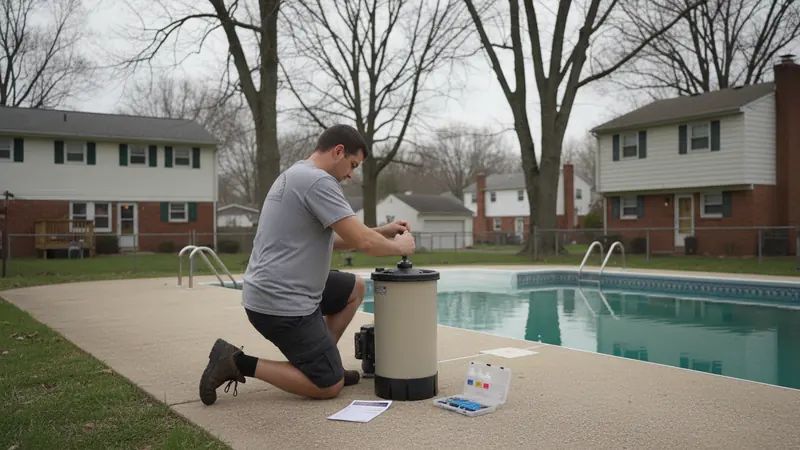
What to check when a backyard pool needs work: permits, county fees, inspections, drainage, and the difference between maintenance and rebuilding.
Every figure on this page carries the date it was gathered. Where the official material leaves a question unresolved, it says so.
Do you actually need a permit?
A cleaning visit, a failed pump and a pool renovation are different jobs. Howard County publishes a residential pool construction process, but the documents reviewed do not provide a complete exemption list for skimming, seasonal openings, liner replacement, pump replacement or resurfacing. There is no defensible single answer to “does pool service need a permit?” without describing the work.
For a pool installation, the county's swimming pool affidavit requires an electrical permit obtained by a licensed electrician. A gas-fired pool heater also requires a plumbing permit obtained by a licensed plumber/gas fitter. These requirements sit alongside the building application; having the pool contractor handle the project does not eliminate the separate trades.
The repair boundary needs a job-specific answer. This page does not interpret silence about maintenance as an exemption for replacement equipment. For a pump, heater, underwater light, liner or shell repair, give DILP the actual scope—including changes to wiring, gas piping and pool structure—and confirm the permits with 410-313-2455, option 4. The construction affidavit is being read here as an installation requirement, not as an order to obtain a new electrical permit for every cleaning visit.
The county's adopted pool code does allow continued use and maintenance of lawfully existing systems when the work follows the original design and creates no hazard. That provision is not, by itself, a permit exemption. It also does not establish that an old installation was lawful merely because it has been there for years.
Source: Howard County DILP, Swimming Pool Affidavit, 2024 ISPSC edition, undated form posted with the September 2025 materials; Resources & Fees, undated; Howard County, 2024 Adopted Swimming Pool and Spa Code, Chapter 1, effective 2025-09-07. Gathered 2026-09-22.
What the permit costs
The FY27 building fee schedule, effective 1 July 2026, has a specific private-pool category. These are government charges, not installation or service prices.
| Private swimming pool building permit | Base fee | With the stated 10% technology fee |
|---|---|---|
| Above-ground pool | $100 | $110 |
| In-ground pool | $250 | $275 |
| Filing fee for this category | None | — |
The schedule says the private-pool permit includes the fence and grading. The totals above are arithmetic from that category alone. They do not include electrical or plumbing permits, engineering, or a contractor's permit-handling charge. They should not be presented as the fee for every repair to an existing pool.
Electrical charges need particular care:
| FY27 electrical schedule entry | Published charge |
|---|---|
| Permit application | $50, subject to listed exceptions |
| Swimming pools, each pool, under the commercial heading | $250 |
| Residential alterations and additions | $50 flat fee |
| Technology fee | 10%, excluding the application fee and base amendment fee |
Do not silently move a fee between categories. The electrical schedule places its pool entry before the residential heading. This page reads it as a commercial-section entry and does not assume that it sets the charge for a backyard pool or a replacement pump. DILP must confirm the applicable category and any application-fee exception at 410-313-2455, option 4. No combined residential building-and-electrical total is claimed here.
A quote can therefore show a verified building fee while leaving the electrical assessment subject to confirmation. Ask for the county charge and the contractor's administrative charge to be separate lines; otherwise there is no way to tell which part is a public fee.
Source: Howard County DILP, FY27 Building Permit Fee Schedule, pages 1–2, and FY27 Electrical Permit Fee Schedule, pages 1–2; both Council Resolution #83-2026, effective 2026-07-01. Calculated building totals add the published technology fee. Gathered 2026-09-22.
What has to be ready before the permit can move
Howard County changed its residential pool submission requirements effective 7 September 2025. Its memorandum requires a site plan locating the pool, and says all plans must be signed and sealed by an engineer. Above-ground submissions need manufacturer installation instructions. In-ground submissions need verification against the county's pool checklist. A compliance certificate is required at inspection.
The checklist goes beyond a sketch of the backyard. For an in-ground pool it asks for the shape, wall cross-section, floor slope, and any diving equipment. The water and diving envelope must show steps and ladders. Slides, stairs, underwater seats and special entries also belong in the submission. Above-ground pools and hot tubs require manufacturer specifications, depth and shape, and weight where applicable.
For a renovation that changes these features, the practical question is whether the proposed work still matches the approved design. A replacement diving board or a changed entry should not be described merely as a cosmetic upgrade without addressing the geometry the county asks to see.
A county-specific pool permit turnaround was not established from the primary sources reviewed. No median or promised approval period is quoted here. An application awaiting engineered drawings is also not the same thing as a complete application awaiting county review. Keep those dates separate when discussing a start date.
Source: Howard County DILP, Requirements for submittal of all residential swimming pool applications, memorandum dated 2025-09-02, effective 2025-09-07; Checklist for Residential Swimming Pool Submittal, undated checklist posted with that memorandum. Gathered 2026-09-22.
The inspections—and when water can go in
The county's inspection booking list separates pool construction from electrical bonding:
| Inspection | Booking code |
|---|---|
| Pool steel | 212 |
| Pool bonding—steel shell only | 309 |
| Pool bonding—perimeter slab or deck only | 310 |
| Final electrical | 304 |
| Final building | 205 |
These are available inspection types, not a claim that every service job needs the entire sequence. The issued permits and work determine which apply.
Book through 410-313-3800, or text Schedule to 888-297-9841 and follow the prompts. After issuance, the county allows requests for the next day or up to seven working days ahead. That booking facility is not a guarantee of permit approval or a contractor's completion date. For a two-hour arrival window, call 410-313-1823 between 7:30 and 8:30 a.m. on inspection day.
An electrical final alone does not authorize filling a newly installed pool. DILP's FAQ says fence approval and functioning door alarms, when required, must be verified; the pool contractor must request the final inspection. Arrange the inspection before the water delivery, rather than treating the delivery booking as the completion deadline.
Source: Howard County DILP, Automated Inspection Request and Permit Information System, distributed in the 2025-04-14 brochure file, with dial-up sheet marked 2024-12-27; DILP swimming pool filling FAQ, undated. Gathered 2026-09-22.
What the inspector is actually going to check
The county's published inspection instructions require approval of bonding and grounding before concrete placement for pool foundations, walls, decks and slabs. That matters when service expands into deck reconstruction: concealed work needs its inspection before the new surface covers it.
Electrical checks include equipment suitability, ground-fault protection, underwater light connections, bonding of metal components and nearby metalwork, and grounding conductors. The inspector also checks the equipment disconnect. A motor running successfully is not evidence that those protections are correct.
The county's newer residential compliance certificate adds a useful way to review the whole job. It asks the installer to address:
- Barriers and decks.
- Suction-entrapment avoidance, circulation, filters, pumps and motors.
- Return and suction fittings, skimmers and heaters.
- Water supply, sanitizing equipment and wastewater disposal.
- Lighting, ladders, safety and equipment rooms.
The installer signs the certificate accepting responsibility for installation and code compliance. For equipment replacement, the useful homeowner question is how the new component fits the existing system—not simply whether its connections can be made to fit. The certificate is evidence of the county's review subjects, not a claim that every listed defect is common locally.
For the enclosure, the county's current affidavit specifies an approved fence at least 48 inches high, plus the required safety devices, before filling. Fence design questions go to Plan Review at 410-313-2436; fence setback questions go to Zoning Administration at 410-313-2350. Height alone does not establish approval.
Source: Howard County DILP, Inspection Requirements, Residential Building—Pools and Electrical—Pools, undated; Certificate of Compliance to the International Swimming Pool and Spa Code for Residential Pools, undated; Swimming Pool Affidavit, 2024 ISPSC edition, undated. The latter forms are posted with the September 2025 materials. Gathered 2026-09-22.
Who is allowed to do the work, and which code applies
Maryland's Home Improvement Commission lists pools, pool covers, permanent hot tubs and pool houses among work usually requiring its licence. Verify the business contracting for qualifying home improvement work through the commission's licence lookup. A pool operator credential answers a different question from a contractor licence.
MHIC's description is not a pool-cleaning classification guide. For a cleaning-only contract, or a mixed maintenance-and-repair scope whose licensing status is unclear, the commission gives 410-230-6231 for clarification. Do not assume either that every cleaner needs a construction licence or that calling repair work “service” removes the licensing requirement.
Howard County's Health Department operator programme concerns public and semi-public pools and requires an approved operator course and county application. Its webpage should not be used to turn a homeowner's backyard service visit into a public-pool operating licence requirement. Community-pool questions belong with Community Hygiene at 410-313-1773.
For construction, Howard County adopted the 2024 International Swimming Pool & Spa Code with local amendments, effective 7 September 2025, under Council Bill 24-2025. Its electrical code is the 2023 NEC with local amendments, effective 3 June 2024. An old estimate or a generic national code summary may therefore describe a different edition from the one governing a new application here.
Source: Maryland Department of Labor, What Is Home Improvement?, revised December 2018, and MHIC licence lookup and programme information, undated; Howard County Health Department, Public Pools & Spas, undated; Howard County DILP, Adopted Codes, effective dates stated above. Gathered 2026-09-22.
What Howard County properties change about the diagnosis
The county's Bureau of Utilities describes its public water and sewer maintenance responsibility as serving the eastern half of Howard County. A pool on a property with private well and septic needs a different site discussion from one connected to public utilities. DILP says properties served by private well and septic require prior Health Department approval for permits; its referral number is 410-313-6300.
That makes the property's utility arrangement useful information at the first visit. Establish the water source, identify where waste water goes, and have the existing site records available before agreeing to a drainage or excavation plan. A street address alone does not establish permission to use a sewer connection or discharge onto land.
A persistently wet area also needs diagnosis. The county offers to investigate suspected water-service leaks and can test for fluoride and chlorine to help distinguish public-system water from groundwater or a spring. Its Utilities customer-service number is 410-313-4900. Wet ground near a pool is not enough, on its own, to prove the pool shell leaks.
No county-specific dataset establishing the leading failures of private residential pools was found. This page therefore does not claim that a particular subdivision has more cracked shells, that older Howard County houses have a predictable pool age, or that local pumps last a stated number of years. House construction dates would not establish those things.
Source: Howard County Department of Public Works, Bureau of Utilities and Customer Service; Howard County DILP, Well & Septic approval FAQ. All undated webpages. Gathered 2026-09-22.
Draining and backwashing are part of the service plan
Howard County explains that storm drains carry water to local streams without treatment. Moving pool water to the curb does not send it to a wastewater plant.
Maryland Department of the Environment guidance says to test water before discharging to surface water or a storm drain: no detectable chlorine or other disinfectant, and pH between 6.0 and 9.0. These are disposal guidance values, not swimming-water targets. The guidance also calls for slow drainage and permission from the sewer authority before installing a sewer connection. Copper- or silver-containing treatment systems need particular attention because their discharges can harm aquatic life.
MDE's 17-SI general discharge permit, effective 1 December 2022 and expiring 30 November 2027, distinguishes discharges requiring registration from those authorized without a Notice of Intent. Automatic authorization still carries conditions; it is not permission to release untreated waste wherever convenient.
A disposal route must be established, not guessed. This page does not classify an individual property's discharge from its mailing address. Use MDE's permit and confirm uncertain eligibility or disposal conditions with its Industrial & General Permits Division at 410-537-3323. A county building permit does not settle the separate discharge question.
Source: Howard County DPW, Stormwater Management Maintenance, undated; Maryland Department of the Environment, Swimming Pool Owner Guidance, undated, and General Permit 17-SI, Parts I and III, effective 2022-12-01, expires 2027-11-30; permit contact page, undated. Gathered 2026-09-22.
What the work is worth—and the refill charge people miss
Verified Howard County prices for weekly service, opening, closing, leak detection, resurfacing and installed replacement equipment were not found in the primary sources reviewed. No national price range is substituted here.
A useful service quote still needs to identify the diagnosis, equipment model, included chemicals, disposal arrangements, permit responsibility, and whether water replacement is included. Separate the work needed to restore operation from optional upgrades so that competing scopes can actually be compared.
For county utility customers, the Finance Department gives an explicit pool-fill calculation: divide gallons used by 748, then multiply by the current water and sewer rates. That is 748 gallons per billing unit. Do not assume that water staying in the pool automatically removes the sewer charge. The county's published pool-fill answer includes both rates; billing questions go to 410-313-2058.
The same page discusses possible sewer adjustments for repaired underground leaks, subject to review. That is not a blanket pool-fill credit. Obtain an account-specific determination before deducting a credit from a repair budget. Private-well water and delivered water require different cost information; this county billing formula does not price either.
Source: Howard County Department of Finance, Water & Sewer Billing, pool-fill and underground-leak FAQs, undated webpage. Formula applies to county utility billing; no current dollar-per-unit rate or private service price is asserted here. Gathered 2026-09-22.
The short version
Describe the repair before deciding which permits apply. Keep building fees, trade permits and contractor charges separate. Resolve inspection requirements before concealing bonding work or arranging a construction fill. Establish the discharge route before draining, and include the refill in the financial decision.
For an existing pool, the most useful service record is a written diagnosis tied to the actual equipment and approved installation. County documents establish requirements; they do not supply a diagnosis, a local failure rate or a contractor's price.
Source: Howard County DILP, residential pool resources and fee schedules, including FY27 schedules effective 2026-07-01; Maryland Department of the Environment, Swimming Pool Owner Guidance, undated; Howard County Finance, Water & Sewer Billing, undated. Gathered 2026-09-22.