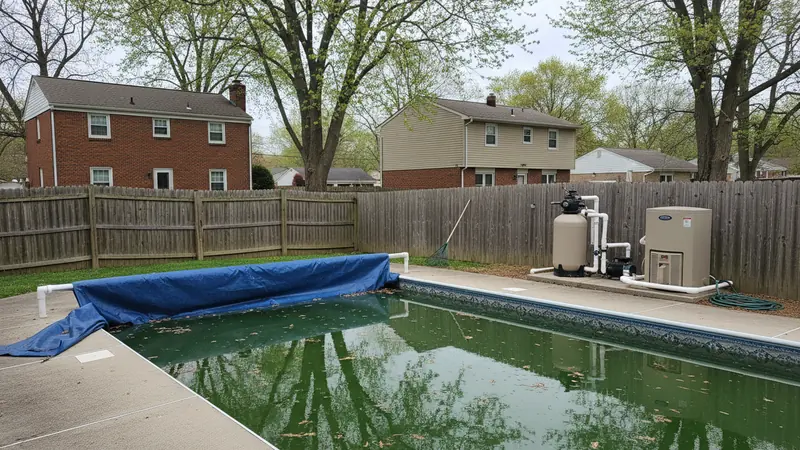
How to separate a failed part from a flow problem, compare repair quotes, and check that replacement equipment works with your Howard County pool.
Start with what stopped working
A pump that runs without moving water, a leaking filter and a heater that refuses to fire need different tests. Before agreeing to replace equipment, ask the technician to name the fault, explain what they checked and identify the part that failed. Photograph the equipment labels and any displayed error before the visit; include what changed just before the trouble began.
Howard County's residential pool compliance certificate treats circulation, suction safety, filters, pumps and heaters as connected subjects. For a repair, that makes a useful question: will the proposed part work with the equipment that stays? The certificate concerns installed pools; it does not establish that every service visit needs a new certificate.
Have the estimate distinguish the work needed to restore operation from optional changes. “Replace pool equipment” leaves too much open. A useful description names the existing model, the proposed part or assembly, any pipes or controls that will change, and how the technician will check the system afterward. Those details let you compare bids without assuming they cover the same job.
Source: Howard County DILP, Certificate of Compliance to the International Swimming Pool and Spa Code for Residential Pools, undated form; no separate effective date stated. Repair-quote questions above apply its equipment categories as homeowner guidance. Gathered 2026-09-23.
Pump trouble: prove the fault before replacing the assembly
Poor flow does not establish that the motor has failed. Pentair's SuperFlo guide identifies suction-side air leaks, insufficient water, clogged baskets and an obstructed impeller among causes of lost prime or reduced output. These are examples from a manufacturer's troubleshooting guide, not evidence that this brand or these failures predominate in Howard County. The technician should use the manual for your actual model.
Ask whether the proposed work replaces a seal, a motor or the complete pump. The SuperFlo guide provides separate procedures for motor and shaft-seal work. An estimate for a whole pump should explain why repairing the affected part would leave a problem unresolved. If the pump lost prime, the quote should also address why water stopped reaching it; the guide warns that running dry damages the seal.
When the work changes electrical connections, have the electrician include the protections Howard County checks: grounding, bonding, applicable ground-fault protection and the equipment disconnect. As the county pool-service page explains, permits depend on the actual scope. A successful motor start alone does not settle those checks.
Source: Pentair, SuperFlo High Performance Pump Installation and User's Guide, revision C dated 2023-07-31, no separate effective date; Howard County DILP, Inspection Requirements—Electrical, Pools, undated, no effective date stated. Gathered 2026-09-23.
Filter trouble: distinguish cleaning from damaged parts
“High pressure” needs context. Pentair's Clean & Clear Plus instructions compare the gauge reading with the filter's original starting pressure and record pump speed when a variable-speed pump is used. Ask the technician to record the clean-filter reading and operating speed after service. Without that baseline, a later reading is harder to interpret.
A quote should distinguish cleaning the elements from replacing elements, seals, a gauge, a clamp or the tank. Ask which part is damaged and whether the proposed part matches the filter model. A leaking tank joint deserves more than a promise to tighten it: the manufacturer's guide requires shutting off the pump and relieving pressure before work, including before tightening the clamp. Trapped pressurized air can force the lid off.
Have the technician check the air-relief valve and gauge and follow the model's restart procedure before leaving. These examples concern a cartridge filter; sand and diatomaceous-earth filters need their own manuals and service scopes. If the job creates backwash or cleaning waste, include where it will go, using the drainage requirements already covered on the county page.
Source: Pentair, Clean & Clear Plus Cartridge Filter Installation and User's Guide, revision U dated 2023-05-10, no separate effective date. Gathered 2026-09-23.
Heater trouble: check water flow before condemning the heater
A heater can refuse to run because the water circuit needs attention. Pentair's MasterTemp troubleshooting chart directs the technician to check that the pump runs, the filter is clear and flow meets the model's minimum when the water-pressure-switch error appears. If those checks fail, it directs service toward the pump, filter and other flow obstructions.
For that fault, ask what evidence points to a failed heater part after flow has been checked. An error message starts the diagnosis; it does not, by itself, establish which part to buy. Ask the technician to record the error, the checks made and the result after repair. Other heater models and electric heat pumps need their own diagnostic procedures.
The equipment pad's height relative to the pool also matters for the MasterTemp models covered by the guide: the manufacturer assigns pressure-switch changes to a qualified technician and describes circumstances requiring a flow switch. If a proposed repair moves the heater, ask how the new position affects those requirements. Keep gas-fitting work explicit in the quote; the county page already explains the separate trade-permit issue for gas heaters.
Source: Pentair, MasterTemp Pool and Spa Heater Installation and User's Guide, heater-position and troubleshooting guidance; revision/effective date not established from the accessible excerpts. Gathered 2026-09-23.
Replacement controls need to suit the job
Howard County's adopted residential energy code addresses heater switches and scheduled controls for heaters and pump motors. It calls for a readily accessible heater power switch, separate from the circuit breaker, that does not change the thermostat setting. It also prohibits continuously burning ignition pilots on gas-fired heaters.
The code generally requires controls that can switch heaters and pump motors on and off to a preset schedule, with stated exceptions. Built-in timers can satisfy that provision. For replacement work, have the contractor explain which provisions apply to the scope and whether the existing controls can remain. These provisions do not establish that every minor repair requires rebuilding the equipment pad.
Make the handover practical: ask the installer to demonstrate the controls, identify who sets the schedule, and leave the equipment instructions. If the quote includes a new controller, ask what it adds and whether the quoted price includes connecting and setting it up. No county-specific energy savings or payback period was established for these repairs.
Source: Howard County/International Code Council, Adopted Energy Conservation Code, residential pool and spa energy provisions, effective 2025-09-07, confirmed by DILP's Adopted Codes. Gathered 2026-09-23.
What the repair costs—and what to settle before signing
No Howard County primary source reviewed supplied residential pump, heater or filter repair prices, diagnostic call-out charges or installed replacement prices. Nor was a county-specific equipment lifespan established. There is no sourced local price range or age cutoff to substitute for an itemized quote.
Ask whether the diagnostic charge counts toward the repair, whether labor and parts are fixed-price, and what happens if testing reveals another fault. Compare repair and replacement using the actual scopes. Have each quote state who covers return visits, what the parts warranty covers, and whether labor is included. Keep the county fees described on the main page separate from contractor charges.
For work covered by Maryland's home-improvement contract rules, the agreement must describe the work and materials and give approximate start and substantial-completion dates. MHIC says a contractor may not take payment before signing and may take no more than one-third of the contract price as a deposit. Put promised equipment models and the agreed price in the signed contract, and keep your copy before work starts.
Source: Maryland Department of Labor, Maryland Home Improvement Commission, Maryland Home Improvement Contracts, undated guidance, no effective date stated. County pricing and lifespan gaps reflect the primary sources reviewed for this page. Gathered 2026-09-23.